

The Narrative (2023)
July 1–August 1, 2023
A narrative can tell stories about a wide range of subjects, recount tales from religion, myth, legend, history, and literature, or examine existential questions such as the meaning of life, death, and the nature of reality. A well-crafted narrative can transport us to another time and place, entertain, educate, and inspire—or help us view the world in a new way, reminding us of our shared humanity and the beauty around us. Tell us: what’s your story?
Featured Artists
Alina Karmadanova, Aly Elliott, Avery Smith, Ching Lin Chang, Cocomi Sasaki, Dan Nelson, Dikye Ariani, Emily Joseph, Francis Sullivan, Gareth Seigel, Giuseppe Curcio, Guy Munsch, Hanna Poliakova, Jacob Watts, Jerry Weems, Jessica Margo, Jin Liu, Joon Lee, Kerrie Bellisario, Kristin Reeves, Laura Mosquera, Louise Williams, M.B Morgan, Margaret Wasiuta, Matthew Johnston, Mattie Sterling, Patricia Fortlage, Ravin Goyal, Sharmon Davidson, Stacy Maiorano, Trudy Denham, Yuqian Sun
A Still Image Has No Before and No After
Narrative photography sets itself an awkward task. Stories require duration, and a photograph has none. What a single frame can do is imply duration — point backwards at a cause and forwards at a consequence, so that the viewer supplies the missing minutes. The thirty-three works in this edition, made between 2008 and 2023 by thirty-two artists, are all attempts at that implication. A few resolve. Most deliberately do not.
The Pregnant Moment
In 1766 Lessing argued that a static art form must choose the single instant from which the imagination can most easily travel in both directions. He was writing about sculpture, but the principle governs visual storytelling in photography exactly. A gesture half-completed reads as story; a gesture completed reads as record. This is why so much narrative photography favours the interval — the hand reaching but not yet touching, the door open but not yet entered, the figure turning away mid-sentence. The picture is not the event. It is the moment from which the event can be reconstructed.
Caption, Title and Sequence
Photographs almost never narrate alone. Titles supply names, captions supply circumstance, and sequence supplies order, and each addition moves a work further from ambiguity toward statement. How much to supply is a substantive authorial decision rather than a housekeeping one. A work titled with a date and a place asks to be read as document. The same image titled with a fragment of speech asks to be read as fiction. Nothing in the print changes; the genre does.
Why Painting Sits Beside Photography Here
This catalog includes works in oil, acrylic and watercolour alongside archival prints, and the juxtaposition is instructive rather than accidental. Painting has never had photography's evidentiary problem: nobody asks whether a painted scene occurred. A painter can invent freely and still be believed as a storyteller, while a photographer who invents risks being accused of deceit. Setting the two side by side makes visible how much photographic narrative depends on the viewer's assumption that something was actually in front of the lens, and how quickly the story changes once that assumption is withdrawn.
Ambiguity Is Not a Failure
The commonest weakness in storytelling photography is over-explanation: a picture that answers every question it raises has nothing left to give on a second viewing. The commonest strength is controlled withholding — enough information to establish what is at stake, not enough to settle it. Barthes's distinction between an image's obvious meaning and its stubborn residue is useful here. The works in this exhibition that hold attention longest are those where the residue is largest, and where the viewer's reconstruction stays unstable after several attempts.
Why the Theme Recurs
Narrative is the most audience-dependent of themes: the same open-ended photograph is read differently a decade later, because the stories viewers bring to it have changed. TCG Gallery is an independent online photography gallery, and each juried exhibition remains part of a permanent public archive after its run ends, so these catalogs accumulate into a longer record than any single project. Photographers can enter the current photography open calls directly.

Bride's Cemetery, acrylic on canvas, 120 x 120 cm, 2022, USD 4500, Alina Karmadanova, Shanghai, China

Audacity of the Sun, archival print on fine art paper, 20 x 16 in, 2022, USD 3000, Aly Elliott, Ellettsville, Indiana

Spring No 14, archival print, 12 x 18 in, 2023, USD 150, Avery Smith, Bloomington, Indiana
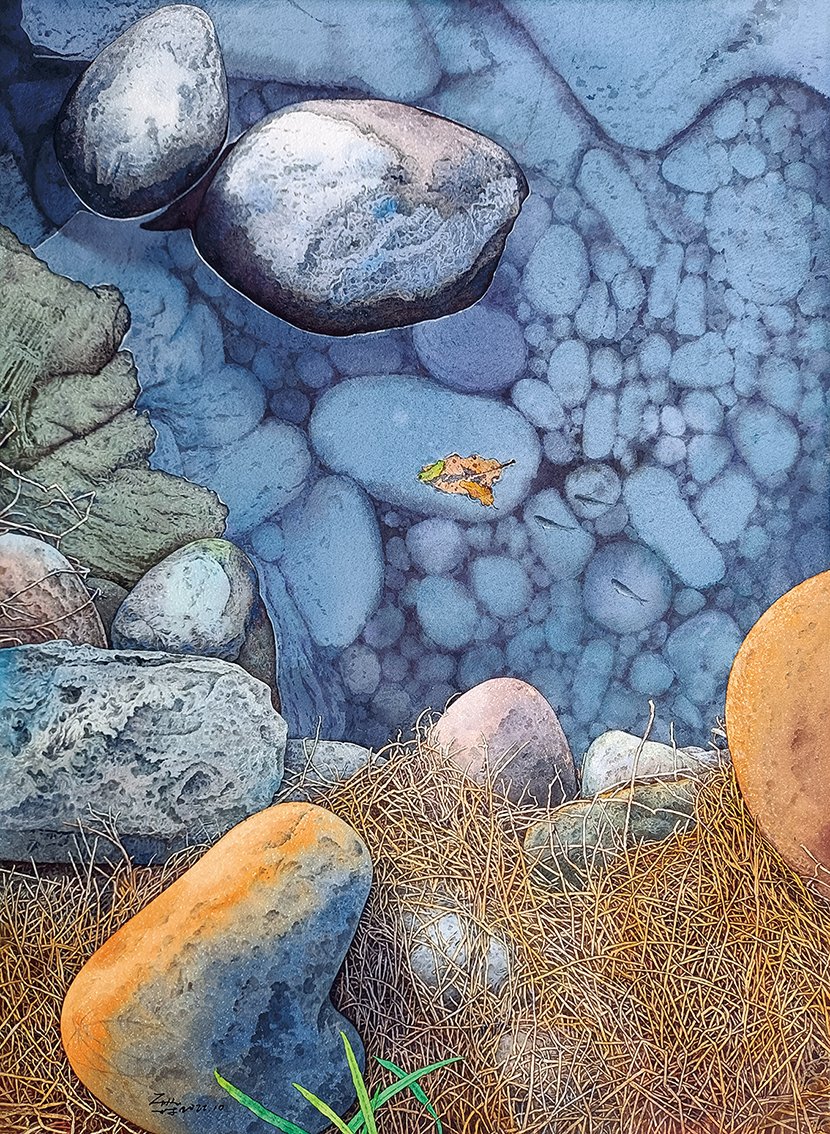
There Is a Spirit in Silence, watercolor on canvas, 56 x 76 cm, 2022, USD 3000, Ching Lin Chang, New Taipei City, Republic of Taiwan

Beauty of Withering Flowers, acrylic on canvas, 91 x 73 cm, 2023, USD 1500, Cocomi Sasaki, New Taipei City, Republic of Taiwan

Who Let the Birds Out, acrylic on canvas, 24 x 48 in, 2023, USD 2750, Dan Nelson, Chicago, Illinois

The Dark Side, archival print, size on request, 2022, USD 750, Dikye Ariani, Jakarta, Indonesia

Forgotten, acrylic and graphite on canvas, 48 x 48 in, 2023, USD 1200, Emily Joseph, Rochester, New York

Art Is, archival print on rag paper, 20 x 14 in, 2011, USD 250, Francis Sullivan, Daajing Giids, British Columbia, Canada

Where Are You, I Can't Find You, archival print, 15 x 15 in, 2008, USD 900, Gareth Seigel, Pasadena, California

Occhio Emotivo, archival print, size on request, 2023, 100€, Giuseppe Curcio, San Floro, Italy

Tea in Hanoi with the Ghost of Edward Hopper, oil paint on canvas, 24 x 24 in, 2021, NFS, Guy Munsch, Silver Spring, Maryland

Mask of Moon, canvas, acrylic, 33 cm x 23.5 x 1.5 cm, 2023, 150€, Hanna Poliakova, Kyiv, Ukraine

Taking Nature, archival print, 14 x 21 in, 2019, USD 700, Jacob Watts, Chicago, Illinois

Chain Gang, oil on board, 26 x 28 in, 2018, USD 8000, Jerry Weems, Ontario, British Columbia, Canada

Best Day Ever, archival print, 12 x 18 in, 2019, USD 250, Jessica Margo, Madison, New Jersey

Dining Table, archival print, 91.67 x 79.4 in, 2023, USD 2600, Jin Liu, Elmhurst, New York

Man with Anger, monotype, 16 x 16 in, 2020, USD 1800, Joon Lee, Englewood, New Jersey

Counting, archival print, 11 x 17 in, 2022, USD 500, Kerrie Bellisario, Denville, New Jersey

Lines (What Is Nothing), found objects, manipulated 16mm film optically printed on cotton rag, 24 x 18 in, USD 500, Kristin Reeves, Muncie, Indiana

Looking For My Life, acrylic and gouache on canvas, 51 x 52.5 in, 2022, USD 5500, Laura Mosquera, Bronx, New York City, New York

So Sad, archival print, 16 x 16 in, 2021, USD 300, Louise Williams, Point Richmond, California

I Need a Place, 10.5 x 13 in, 2023, USD 850, M.B. Morgan, Nashville, Tennessee

Ananke, acrylic on canvas, 40 x 34 in, 2020, NFS, Margaret Wasiuta, Toronto, Ontario, Canada

I Am Not Alone, platinum/palladium print, 7.5 x 11 in, 2023, USD 500, Matthew Johnston, Olympia, Washington

John, Dear! (The Yellow Wallpaper), oil on canvas, 48 x 48 x 2 in, 2020, NFS, Mattie Sterling, Savannah, Georgia

Babylon, archival print on fine art paper, 24 x 30 x 1.5 in, 2023, USD 1600, Patricia Fortlage, Monrovia, California

The Rise, archival print, 24 x 36 in, 2022, USD 1150, Ravin Goyal, Studio City, California

Caretakers, 18 x 14 in, monotype with mixed media, 2023, NFS, Sharmon Davidson, Taylor Mill, Kentucky

Siege, oil on canvas, 24 x 36 in, 2023, NFS, Stacy Maiorano, Bridgewater, New Jersey

Guardian of Pirate Cove, archival print on cotton with sewn thread, 6 x 27.5 in, 2018, NFS, Trudy Denham, Chadron, Nebraska

Artificial Fairies No. 9 (Listener), watercolor and ink, 43 x 61 cm, 2022, USD 3200, Yuqian Sun, Toronto, Ontario, Canada

Artificial Fairies No. 10 (Dissonance), Watercolor and ink, 48 x 74 cm, 2022, USD 3200, Yuqian Sun, Toronto, Ontario, Canada
Sales and Artist Inquiries
Are you interested in making a purchase or connecting with one of the featured artists? Send us an inquiry through our contact form, and we'll get back to you shortly. We accept Apple Pay, PayPal and Stripe.