By Vincent Guglielmo, TCG Gallery
The fire marshal deserves some of the credit.
In 2021 we had a show booked for the Louisville Photo Biennial. We had a Victorian mansion in Old Louisville to hang it in, and a fire marshal who had just explained, with a clipboard, that the building was no longer hosting the public. The photographers had already sent us their work. So we put the show online. It was a complete disaster.
Five years later I run the gallery from New York and spend a surprising amount of my week asking Europeans to photograph the backs of paintings. There were some steps in between. None of them involved a plan.
If you knew me in Louisville, Kentucky as Vyncex Gorlami: same guy. Some of you laughed at the memes. Some of you had opinions about how to pronounce Louisville. Almost nobody got the Inglourious Basterds joke. I wore it for years anyway, the way you keep a joke going at a party long after the person who'd get it has gone home.
To everybody who has sent us a photograph in the last six years: thank you. This whole thing started with your pictures, and you deserve to know what happens when we open one.
What we do to your JPEG
Mostly we read what's already in it. The camera, the lens, the exposure, the software that last saved the file. Sometimes all we get is "Adobe Photoshop," which narrows the field to roughly every photographer alive. If a picture looks familiar, we run a reverse image search. Now and then this leads to the shocking discovery that a photographer has put their own photograph on their own website. Case closed. Nobody goes to jail.
I'd put the share of submissions that get a second look at about 3 to 4 percent. That's my guess at how often I have a question. Usually it's how much of the picture was composited or retouched, because what's allowed changes from call to call. An empty camera field tells me almost nothing. If you scanned a negative and can't remember what you shot it with in 1987, just say so. Please don't make up a camera so the form looks finished. I can tell when a Hasselblad has been retroactively added to a photo that was clearly taken by a disposable from a gas station, and I respect the gas station more.
We read metadata on our own computers. A reverse image search sends the image to whichever service does the searching. We also use a commercial AI assistant to organize submissions and suggest pairings. It's annoyingly good at spotting the same curve in a coil of rope and a rock. Take both pictures out of the show and it's still right about the curve.
I pick the show. We don't train models on your submissions, and we don't keep a separate library of your images from those checks. I turned off model improvement in ChatGPT. What I did spend months training was the assistant's habit of showing me where it got something before I believed it. That turned out to be the most useful thing I've ever taught anything, including several interns.
This got out of hand fairly quickly
For about two weeks I had it reading almost nothing but art history. It would bring me three sources that agreed on what happened to a painting. I'd ask for the catalogue. Then the page. Then the photograph. A remarkable amount of agreement among three sources disappears once you find out two of them copied the first one. Scholarship, it turns out, has a forwarding problem, like your aunt's emails.
One night I asked whether it could find a painting stolen by the Nazis.
About an hour later it had one worth checking. We compared the photographs, checked the records and sent the evidence to the Max Stern Art Restitution Project. Within about a week we heard there was an agreement in principle to return the painting. I'd set aside that week to figure out why the computer was wrong. That was a hell of a thing to hear instead.
The return is still pending as I write this. The people handling it will name the painting when they're ready, and not before, because that's how this works.
Since then, "one night" has turned into a habit. I now run several of these assistants at once, and they disagree with each other, which is the healthiest thing about them. One of them twice tried to convince me that a portrait of a woman holding fruit was a missing still life. It was a portrait of a woman holding fruit. Her name was on the label. The machines are fast, but somebody still has to look at the picture.
"But somebody paid for it."
I believe you. If somebody sells you my car stereo in a parking lot, I'm perfectly willing to believe you paid him. I'd still like to know what he was doing in my car in 1985.
Buying a painting the Nazis forced onto the market can leave you with a real receipt and a serious title problem. Take lot 181 at Lempertz in Cologne, November 1937: Franz Xaver Winterhalter's Girl from the Sabine Mountains. A real painting, a real auction, a buyer we can name. Karl Wilharm bought it. The question is whether Max Stern had any choice about selling it.
As it happens, we know what Stern thought of the arrangement. When the Nazi authorities ordered him, a Jewish dealer in Düsseldorf, to liquidate his gallery, he appealed. He lost. His pictures went to auction, he fled Germany, and the regime made sure he never collected the proceeds. Decades later Wilharm's stepdaughter inherited the Winterhalter and consigned it to an auction house in Rhode Island. In 2007 a federal judge ordered it returned to Stern's estate, and the order held on appeal in 2008 (Vineberg v. Bissonnette). You could transcribe every word of that 1937 catalogue perfectly and still miss that the man selling the painting had already tried to say no.
That's the whole problem in one picture. The paperwork from a forced sale looks exactly like the paperwork from a normal one. Same catalogue, same gavel, same little numbered plates. The difference is in who was standing in the room, and who wasn't allowed to be.
The records were destroyed, and you can read them on your phone
Two years after Stern's sale, the same Cologne auction house ran another one. In December 1939, on the orders of the public prosecutor in Düsseldorf, Lempertz auctioned about 700 paintings belonging to Walter Westfeld, a Jewish dealer from Wuppertal. The catalogue's title says "aus nichtarischem Besitz," "from non-Aryan property." That wasn't a euphemism. It was a category, and it appeared on the cover. Westfeld was arrested and deported, and he never came back.
In 1947 the woman he had named as his heir wrote to the auction house asking what had happened to his pictures. She was told all the relevant records had been destroyed.
That catalogue is now scanned and free online at Heidelberg University Library, page by page, including the lot numbers. I've read it on my phone. In 2008 the heirs filed a lawsuit with a copy of the catalogue and the price list attached. The records were not as destroyed as advertised.
I'm not telling you this to dunk on one auction house. In 2010 the same house resold a Westfeld painting with a printed note about an "amicable settlement" with the heirs, and donated its buyer's premium to a Jewish charity. People and institutions change, sometimes. I'm telling you because "the records are gone" is one of the most common sentences in this field, and one of the least reliable.
Things also go the other way. When the Westfeld heirs sued Germany in the United States, the court threw the case out on sovereign immunity. The appeals court accepted that the seizure was an abuse of state power and still ruled that "Congress did not create an exception for lawless activities." Elsewhere, a Westfeld portrait ended up with a small German town, and the mayor, asked about returning it, reportedly said the international agreement on looted art didn't bind them, and anyway, Walter Westfeld was dead.
He was. That was the point.
Please turn the painting around
We're photographers. Much of what survives of these collections is a photograph, often a lousy one: a halftone plate in a 1930s auction catalogue, printed on paper the color of weak tea. Our job is to put that picture next to a modern one and decide, honestly, whether they're the same object.
Things that are not evidence, no matter how exciting they feel at 2 a.m.:
The same title. There are more paintings called Winter Landscape than there are winters.
The same size. We once had two pictures with identical dimensions, same painter, same decade. One was boats on the ice. The other was boats on open water. Sizes match all the time. Pictures don't.
The same painter. Painters repeat themselves. Some of them did it for a living.
A story. Every family has one. Some are true. We need the page.
Things that are evidence: the crack running across a halo in the same direction, the dog in the same spot, the cloud with the same notch in it, the date painted in a corner, the label on the back.
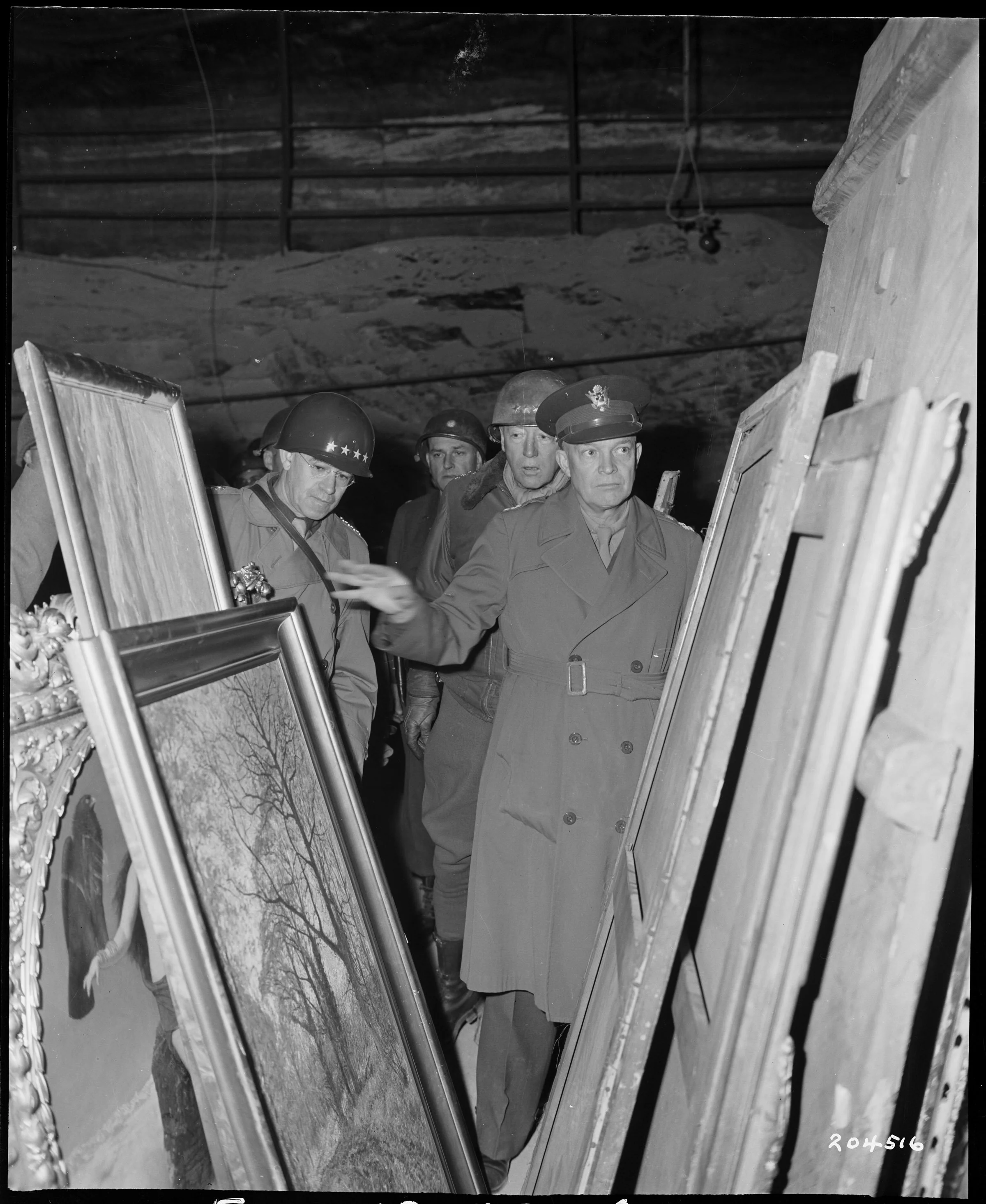
That last one is where photographers come in. Provenance is about as close to metadata as a painting gets. The trouble is that some of it is in France, some of it is in German, and some of it is written in pencil on the back of the thing you'd like to see. Dealers' stock numbers, auction lot stickers, customs stamps, collecting-point numbers written after the war by American soldiers sorting what they'd found in salt mines and castles. Those few digits on a strip of paper can do more than any expert's opinion of the front.
France has a beautiful example in its public Rose-Valland database. On the back of the mount of a drawing called Cour d'un palais, somebody wrote 332 in the corner of a label. The same number appears on the paperwork for a shipment from Baden-Baden to France in January 1948. You can look up which crate the drawing traveled in. There's still a gap in its ownership between 1933 and 1945. Imagine being able to answer "Which crate?" and still be stuck on "Whose drawing?" That's an ordinary afternoon in this line of work.
How a lead actually gets made
The method is simple and boring, and boring is the good part. Every lead has to clear three things:
The owner. Was the person who lost it persecuted, and did they lose it to seizure, a forced sale, or a sale they made to pay for their own escape?
The object. Is the thing at auction or in the museum the same physical painting? Not a version, not a copy, not a cousin with the same name. Photographs first; numbers after.
Open or closed. Has it already been returned, settled, or paid for? A surprising number of exciting finds turn out to be paintings that were dealt with in 2011, and the heirs would like you to stop calling.
If it clears all three, we don't post it. We send it to the people with standing: heirs, their lawyers, the claimant organizations and the national registries. We write it up so a busy person can check it in ten minutes. Then we wait, which I hate, and which is correct.
If you want to look yourself, nearly everything we use is public:
Lost Art (lostart.de): Germany's register of losses and found objects.
German Sales at Heidelberg University Library: auction catalogues from 1901 to 1945, scanned.
The Getty Provenance Index: sale records and dealer stock books.
The Rose-Valland database: France's records of what came back after the war.
Bring patience. Some of these sites will ask if you're a robot. Some days, fair enough.
Things I've learned that I didn't expect to
Archivists write back. Librarians write back. Auction-house specialists write back, sometimes faster than my friends do. Six years ago a fire marshal was counting how many people I could legally fit in a room in a crumbling mansion. Now I can write to someone with a doctorate about three digits on a piece of cardboard and get a serious answer. I try to earn that by sending the catalogue page, circling the mark and asking exactly one question they can reasonably answer.
I've also learned that the most dangerous phrase in provenance is "private collection." It can mean a respectable family that has owned a painting since 1890. It can also mean "we'd rather not say." The difference is usually in the years. Pay attention to whatever is happening between 1933 and 1945. If a painting's history jumps from a Berlin auction in 1938 to "private collection, Bavaria" with no names in between, that's not a gap. That's a sentence somebody decided not to finish.
Got a tip?
Did your grandfather leave you a suspiciously nice painting over the mantel, along with a family history that gets vague around 1938? Or has your family spent eighty years looking for a painting whose last known photograph is also a photograph of your grandmother's living room? Either way, we'd like to hear from you. Nobody is getting in trouble for writing to us. Finding things out is the point.
How to send it so we can actually use it:
Send the whole photograph. Leave the edges in. Don't crop out the frame.
Photograph the back. Shoot it flat, in good light, with no flash glare. Get close-ups of every label, stamp, sticker, number and scribble, even the ones that look like nothing.
Put a ruler or tape measure in one shot.
If you have the auction catalogue, send the page and the date of the sale.
Tell us what you know, and tell us separately what somebody told you. Both are useful. They are not the same thing.
If you can only read three digits on a label, send the three.
And please put your name on the damn file.
Send a tip to TCG Gallery.
Photograph: Dwight D. Eisenhower inspects recovered artwork at the Merkers salt mine with Omar Bradley and George S. Patton, April 12, 1945. U.S. Army, National Archives, 111-SC-204516. Public domain.