

Why We Keep Photographing the End of the World
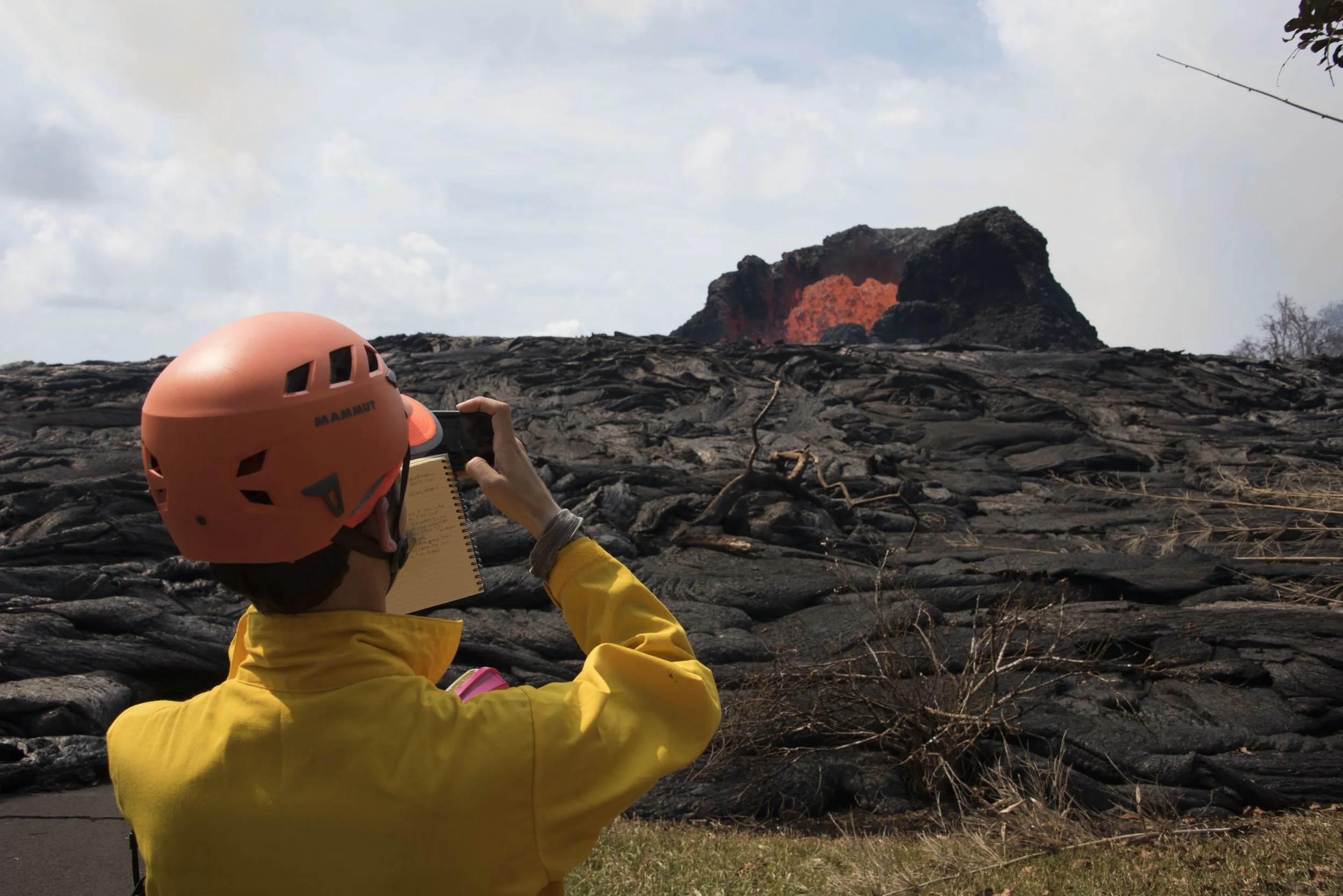
Matthew Patrick, a USGS volcanologist, documenting Kīlauea’s eruption in Leilani Estates, Hawaiʻi, May 27, 2018. USGS photograph; public domain. Source and usage information.
Fire, floods, violent weather: why images of destruction can be beautiful, and what that beauty does to our response.
Something terrible is happening in excellent light.
Smoke rises into a sky that has gone an improbable shade of violet. Water fills a street and turns the windows into reflections. Fire draws a bright line across a dark landscape. We understand that the situation may be dangerous. Somewhere in the same thought, we are also thinking: look at that light.
This is an awkward thing to admit. Photography makes us admit it.
We keep photographing scenes that look like the end of the world because they are visually extraordinary, because we want a record, and because a frame gives us a manageable piece of something much larger than ourselves. The photograph lets us look at what we might otherwise turn away from. It also lets us look from a very comfortable distance.
The weather has done half the work
Fire supplies color. Smoke simplifies a background. Lightning provides an extremely unreasonable lighting budget. A flood can turn a familiar place into a landscape nobody recognizes.
These subjects arrive with an advantage. They can overwhelm us before we have considered a single decision the photographer made. The spectacle gets the first look. Composition, timing, distance, and the choice of what stays in the frame determine whether there is a second.
In Mark Dierker’s Fire & Water, shown in Elemental, a huge cloud occupies most of the photograph. Violet light and a lightning strike give the sky an almost theatrical presence. The thin strip of land beneath it makes the scale legible. We can admire the photograph while feeling how little room it leaves for us.
That mixture of attraction and unease is one reason images of immense natural force hold our attention. A cloud becomes beautiful and intimidating in the same encounter. We do not have to resolve the feeling before the photograph works.
Beauty gives us a way in
A beautiful image can make somebody stop long enough to encounter a difficult subject. Color, pattern, and light are ways of directing attention. They can keep an event from disappearing into the general category of terrible things happening somewhere else.
In Sudheer Nunna’s Inferno Unleashed, orange channels of lava spread across darkness beneath an intense glow. The eye follows their branching paths. We find ourselves studying the shape of something we would instinctively keep our distance from.
There is value in that sustained looking. A photograph can make a force tangible at a scale the viewer can examine. It can bring an unfamiliar place into somebody’s attention. It can preserve a view that will change.
But attention has several possible destinations. We might become curious about the place and what happened there. We might appreciate the photographer’s decisions. We might save the image because the orange would look tremendous above the sofa.
A photograph can attract us without getting any further than attraction. Its beauty opens an opportunity. What we do with that opportunity remains a question.
The frame makes things manageable
Inside a photograph, even a chaotic event acquires edges. The image has a beginning and an end. The viewer can step back, enlarge it, close the tab, or move to the next work.
Life outside the frame has fewer accommodations. If the image records a disaster, somebody may still be dealing with a damaged home, interrupted work, missing possessions, or a place they can no longer reach. The photograph’s visual order can coexist with a situation that remains thoroughly unresolved.
The danger is that we mistake the pleasure of looking for an adequate encounter with what happened. We have spent thirty seconds admiring a reflection. The reflection belongs to a flooded street. There may be more to learn.
This is where context matters. A location, a date, and an accurate account of the event give the image something beyond atmosphere. If people were affected, their circumstances deserve more than a dramatic adjective. If the photographer does not know what happened beyond the visible scene, the caption should make that limit clear.
A title such as Apocalypse can create a mood. It leaves the rest of the work to somebody else.
Whose world is ending?
The phrase “the end of the world” is convenient because it is enormous. It can also be evasive.
A photograph may show a natural process, a weather event, a human disaster, a constructed scene, or something whose circumstances we do not yet understand. The same visual language—smoke, darkness, orange light—can appear in all of them. Before we turn the image into a verdict about the planet, we should find out what we are looking at.
And when there has been loss, scale changes with the person describing it. The destruction of one home can end the world somebody knew. A distant viewer may see a remarkable arrangement of debris. Those experiences belong to the same place, but they carry very different weight.
Photographers can hold that difference open. The spectacular image may sit alongside the ordinary aftermath: the room being emptied, the familiar route interrupted, the object somebody bothered to retrieve. Specific details let us understand a place through something besides the magnitude of the event.
There is a temptation to keep every frame at maximum volume. After enough smoke and dramatic skies, the photographs begin competing to be the loudest emergency in the room. A quieter image can give us somewhere to put the attention the spectacle attracted.
Give us somewhere to go after “wow”
We are interested in photographs that keep developing after the first impression. The immediate beauty may be the reason we enter. We want the image, its context, or its place among other photographs to reward staying.
For photographers, that means taking the second encounter seriously. Look at what the frame explains and what it leaves unknown. Decide whether another image in the sequence would complicate the first. Give the caption enough factual precision that the viewer can distinguish your interpretation from the event itself.
For viewers, it can begin with a very small act: read the caption. Learn where the photograph was made. Let the place acquire a name before it becomes another impressive background.
Beauty can draw us toward something difficult. It can also furnish a pleasant place to stop. The difference emerges in the attention that follows.
The sky has already done an excellent job of getting our attention. We can take it from there.
Elemental: Earth, Air, Fire, Water is on view October 1–31, 2026. View the exhibition and participating photographers.